Makin’ Copies

I have settled in to working at Dar al-Kutub (the “house of books”), the Egyptian national library.

Before I proceed, I was challenged to demonstrate that the library is infested with cats.
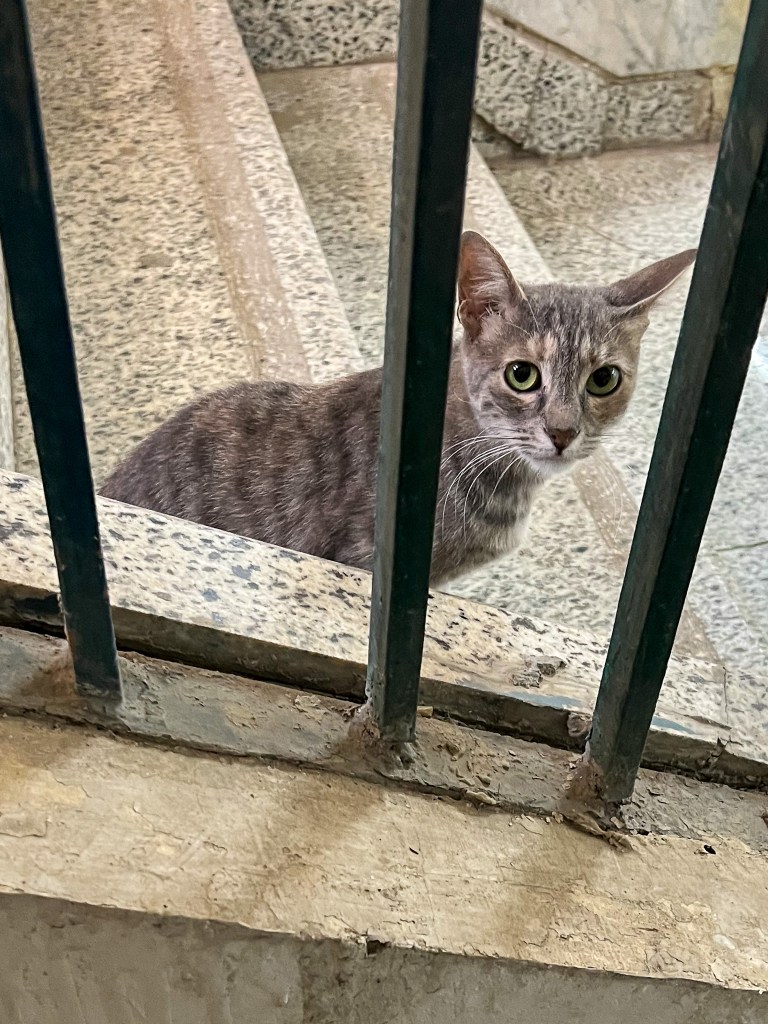
These two met me on the stairs. The cats generally seem to live in the utility core of the building, and enter the people part whenever someone has food or occasionally to scream at the top of their cat lungs.

The periodicals room is on the second floor, in the back, poorly marked, and the microfilm room is in the back of that. It is overseen by two and a half women whose names I haven’t learned yet but will eventually as soon as I get over my fear of them.

None of them speak English, which only adds to the comedy of errors.

The one who wears the white hijab seems to be in charge. She is the one who spent a good portion of the first morning I was there giving religious advice on the phone to someone. She seems to get me, by which I mean she understands my broken Arabic and has something of a sense of what I’m trying to accomplish there and is generally the most helpful when I have a question.

The woman who sits by the door wears the niqab (the face mask with a slit for the eyes). She is terrifying; not because she wears the niqab but because she has little patience for me and has (and I cannot emphasize this enough) no sense of humor. This will become relevant shortly.

There is a third woman who occasionally arrives and occupies a desk and seems to belong there, but I’ll be damned if I know what her function there actually is. This is a not uncommon theme in Egyptian bureaucracy — the stereotypical visit to a government office is to find a room full of people playing on their phones and the one person who can do whatever you need is not there, having decided within the last five minutes to go to visit his mother in Minya (200 miles south). He’ll be back in an hour or next week, inshallah.

Having spent two days going through all of Al-Garida (which literally means “the newspaper” — clever title, that) for the period of July-December 1914, I had written down a list of headlines that I wanted to photocopy so that I could go through them at my pace (my ability to skim Arabic quickly is limited, so I mainly look at headlines and then write down the date, page number, and headline of what I think will be useful).

Every time my phone came out I got scolded (no pictures!), and eventually when I explained I was using Google Translate to look up a word I didn’t understand, we came to an agreement that I could use the phone as long as I didn’t point it at the microfilm machine.

Tasweer, photography, must be done on the 6th floor. I heard this again and again. An American professor who was there when I arrived the first morning told me this as well, as well as describing that the process was a bit convoluted. She asked me when she finished describing it “Did that make sense?” to which I responded, “I understood the words you just said, yes.”

Here is how my tasweer experience went. I am using the Arabic for a reason, which will become clear soon.

I arrived on Thursday morning (Thursday is the end of the Egyptian workweek), knowing that tasweer is on the 6th floor. What I was unclear about is whether I am supposed to take the microfilm reels up to the 6th floor myself, or whether the people from the tasweer would come and get them. So, before heading to the 6th floor, I stopped in at the periodicals desk to ask.

This was my first mistake, you see, because I asked a direct question. My question was, “Do I take them myself,” and the answer was, “No, they will come and get them.”

Thus enlightened, I took the elevator to the 6th floor.

Alighting from the elevator with the hole in said floor, I exit to the lobby where I find … nothing. There’s no signs. There’s a door to the right at the far end that says DIRECTOR OF THE NATIONAL LIBRARY. I assume this is not the place to get photocopies made.

I do poke my head in to look and it doesn’t seem like the kind of place where people do things.

I go to the left and discover a hallway that extends from that. It’s full of broken toilets (as in, toilets that have been sledgehammered into pieces).

I look back to the director’s office, shrug, and proceed past the broken toilets which are, in point of fact, pushed to the side. I also notice that the restrooms appear to be in the process of being redone, by which I mean that the doors open into a yawning chasm of nothingness in which workers appear to be constructing things from the cinderblock frame of the building back out.

There is a door at the far end of this office. I emerge into it and discover (on the side of the door that would face outward if it weren’t open) that this is the khidmat al-tasweer, the photography service.

In which there are five men doing absolutely nothing. None of them appear to notice me. I start with “good morning.”

Someone reluctantly gets up. “Hi, I want to request some tasweer.”
“Do you have your request form?”
“My what?”
“Your request form.”
“No. Where do I get that?”
“What do you want to tasweer?”
“Microfilm.”
“You get it in the microfilm room.”

Because, you see, I had asked whether I needed to take the microfilm myself … but hadn’t backed up enough to ask the more pertinent question of “How do I tasweer the microfilm?” Always ask open ended questions.

I choose to take the stairs down to the second floor. This is where I encounter the cats I photographed above.

This time I go to the microfilm room. Lady in white headscarf is there. “Good morning,” say I. “I need to request tasweer.”

Hamdulillah you are doing tasweer,” she says. “As you can see, the power is out.” (It is, although I hadn’t really noticed. It’s not a well-lit room.)

She hands me a form. I am to list the title, date, and page number of everything I want to tasweer.

I have 76 items. I check with her to make sure I am writing the dates correctly as I’m uncertain of the ordering in Arabic, but we get there.

I hand her the list.

She hands it to the niqabi lady.

Niqabi lady has a full on meltdown.

“HE WANTS THE ENTIRE YEAR???”

“No,” say I, “just half the year.”

She does not find this funny.

I then realize the reason that she does not find this amusing is that she has to copy each of the entires I have made on MY form onto HER ledger, and that what I thought I was doing (being efficient by requesting all the copies I needed off of the entire roll at once) was causing her a massive amount of work.

I offer every placating phrase I can think of (and it turns out I know many). It’s possible she’s no longer praying for my safe and rapid return to the US (like, today), but time will tell.

Head lady grabs the form and goes to the office next door. I hear very loud discussion — although, to be fair, Arabs themselves joke that their conversations sound aggressive, so this could either be a legit argument or discussion of weekend plans. I hope it’s the latter.

When she returns, she informs niqabi lady that they can simply write down the months I am requesting, but not the dates. This done, I am handed the form and given leave to Take The Form To the Sixth Floor (elevator with hole).

There are now even more men in the khidmat al-tasweer not doing anything. I present my form, and notice that one of the computers is doing something.

Up to this point, I had been told that tasweer was photocopying, and I had been proceeding on the understanding that requesting the pages individually meant that these were the pages that would be tasweered.

However, one of the men is watching a computer screen advance … as it scans an entire reel of microfilm. He’s not doing anything, mind. It’s scanning automatically.

The head gentleman informs me that my tasweer will be ready in an hour.

I have a lunch date, and am worried about making it on time (it’s with Fulbright people so I need to go home and change first), so I ask if I can come back Sunday. The look on his face suggests that this might not be the stupidest thing he’s ever heard, but it’s clearly top five.

“One hour,” he said. “See Mr. Raheem on the 3rd floor.”

“One hour,” I repeat. “Mr Raheem. 3rd floor.”

I kill an hour trying to look things up on the National Library catalog (I’ll discuss this later) and go to the 3rd floor where I ask for Mr. Raheem.

This is digital services. A massive, bright, clean workroom with loads of computers in it and three desks against the wall of windows. I go over and ask for Mr. Raheem.

Mr. Raheem, it turns out is, named Mr. Hussam.

Mr. Hussam has no idea who I am, but this does not phase him. He invites me to sit down and calls up to tasweer. I don’t know what they tell him, but he returns to work and I play on my phone for another half hour.

I am on the verge of suggesting I come back Sunday when one of the men who wasn’t doing anything appears with my form in hand. The reel has been scanned, it’s on the server, and Mr Hussam loads it up.

And herein I learn my next valuable fact. I cannot ask for the entire reel. I requested permission to tasweer these 76 pages, and these are the pages I will get.

And so … we spend the next hour going through the reel (which has been scanned to PDF) … so that I can identify the pages that I wanted because, of course, now the numbering is off and we have to find them again.

Finally, Mr Hussam counts up the number of usable pages (for reasons I cannot identify, the reel that was scanned does not appear to be the same reel I looked at, and we’ve lost one of the pages because this version had a massive tear in the middle of the page), and writes up an invoice. “5th floor,” he says.

I go to the 5th floor and am ushered into an office that resembles Tony Soprano’s office in the back of BadaBing! in more ways than one. I am asked to sit down (patience, grasshopper) and wait for the guy on the phone to finish his call. I make small talk with the other gentleman present, whose primary function appears to be holding a cup of tea. He offers me a cigarette. I decline.

At some point, without ending his call, the guy on the phone asks for LE 305 (just over $10), which I give him, and he hands me a receipt to take back down to the 3rd floor and give to Mr Hussam. He hands me a CD of the images, and we conclude our business. He is a very pleasant person and possibly the only employee I’ve met who appears to enjoy his job.

Elapsed time, 3 hours 35 minutes.

Lessons learned: in future, request a few scans every day. It will make everyone happier.

Also: no one in Egypt uses CD-ROMS anymore. I eventually got the nice man at Radio Shack to transfer them onto my USB drive.

Updates from the field.

I’ve posted some of this on Facebook haphazardly; eventually I’ll want to share this more widely (but for now, password protected as I am under orders not to say things that might be construed as negative about my hosts).

The trip to Egypt was as onerous as any 24 hours of travel can be. Enough said there. I got to Austin airport at 3 pm on Sunday, and landed in Cairo at 11 pm Monday which, given the time differences, was exactly 24 hours.

The promised expeditor was waiting for me and hustled me through passport control as quickly as he could; then I discovered that my luggage, which American Airlines had meticulously informed me had followed me as far as London, had not been loaded onto the final flight. My sinking feeling was confirmed when he let me connect to his mobile hotspot to check the AirTag I had put in my bag, which confirmed that it was still sitting at the south end of Terminal 5 at Heathrow. After filling out the paperwork and changing some money, it was well past midnight when I finally got into the car that had been arranged to bring me to the apartment I didn’t know anything about.

I had the address and knew that the apartment was located about two blocks off of the main drag in Zamalek, a neighborhood I know well as I lived here (albeit at the other end) when I was doing my study abroad in Cairo as a junior almost 30 years ago (and boy, does it kill me to write those words) and have stayed in or near on every subsequent return visit to Egypt.

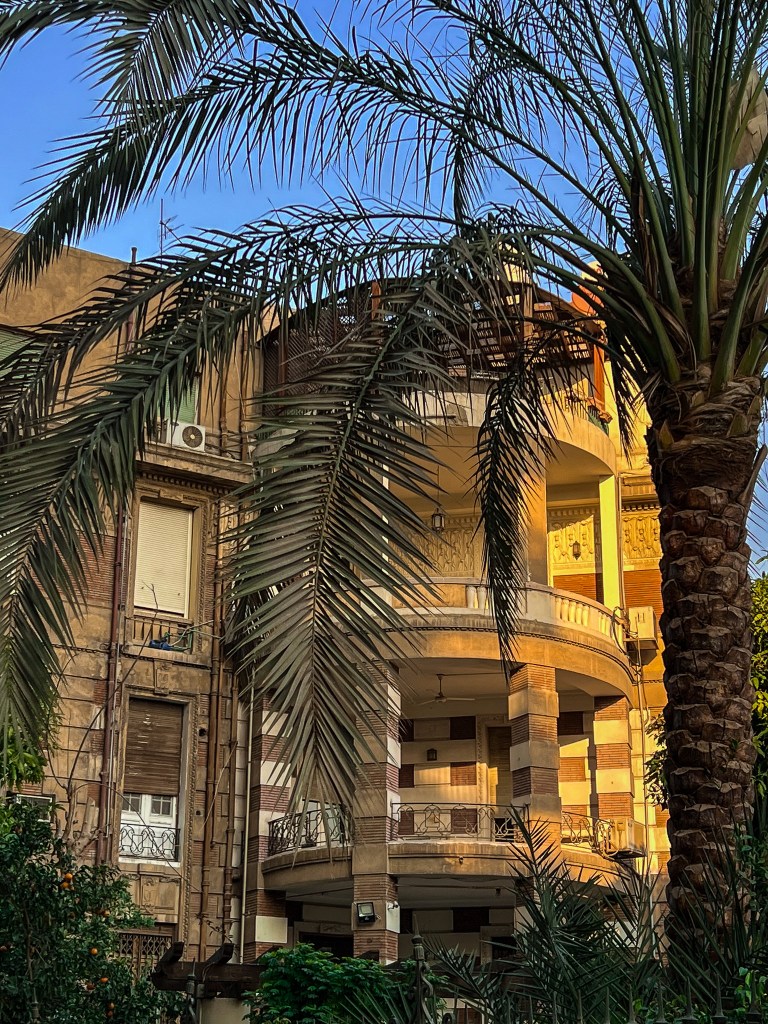
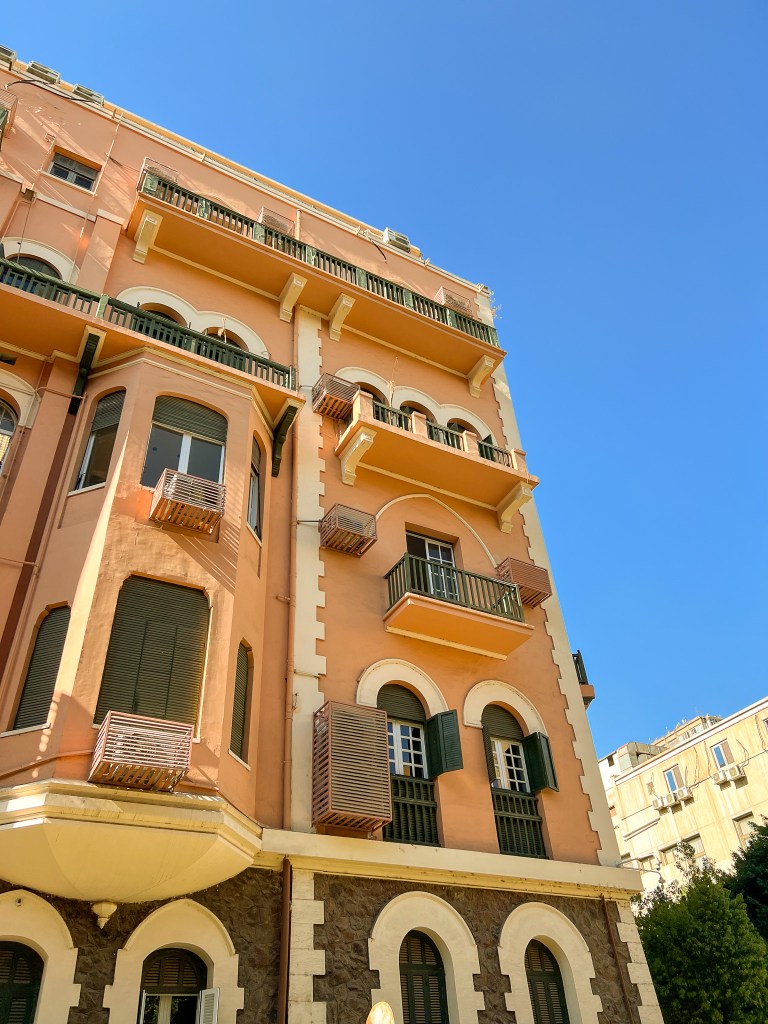
Even at 1 in the morning, there were three men from Fulbright who met me at the flat, which turns out to be a palatial three bedroom in a building constructed, as the plaque on the front door informs me, in 1945. The kitchen and bathrooms have been updated since, and, in addition to a washing machine, it possesses that rarest of Cairo perks: a dryer.

It was past 2:30 when I got to bed and I didn’t sleep very well. The next morning, my first task after breakfast was to purchase undergarments. The receipts have since been submitted to British Airways, god knows if I’ll ever see the money.

Egypt is in the midst of a massive currency crisis; the Egyptian pound (abbreviated LE, livre Egyptien), has lost a third of its value since the beginning of December. Things are pricey—the last time I was here the exchange rate was 8 to the dollar, now it’s 30!—and I nearly had a heart attack when I was presented with a bill for a thousand pounds for two t shirts, two of the most hideous (but allegedly cotton) pairs of underwear I’ve ever bought, and two pairs of socks. In my student days that would have been prohibitively expensive; now it’s barely $30.

Did I need to go to The Body Shop for soap and shampoo? Probably not, but I’m worth it, dammit.

The currency crisis means that imported items are hard to come by and stores just randomly go out of stock on things all of a sudden (shaving cream is, for some reason, a hard to find item). While, on the one hand, I bought an external monitor for my laptop for $130 (24” and curved!), I’ve also given up ordering groceries (for everyone and everything delivers here) because invariably there’s an awkward call shortly thereafter where they try to explain to me in their best Arabic-English pastiche which items I just ordered that aren’t in stock. I’d rather just go to the store and see what’s there.

I told Victor that this reminds me of shopping for Christmas dinner in Mexico before HEB opened in Irapuato: making the rounds of at least four stores, and then figuring out where to get the one or two items that we still couldn’t find.

Fortunately, now there’s Amazon and its better stocked, Saudi owned competitor, Noon, which will deliver things direct to my door.

Getting into the research

Research in Egypt isn’t easy. It’s why I’m here, but, whereas in the UK, I showed up at the National Archives, showed my passport and got a reader’s ticket from a bored looking woman in a headscarf, that is not the case here.

I had to send off paperwork to apply for permission to work in the Egyptian National Archives (which is separate from getting permission to be in Egypt, which was a prerequisite for getting the Fulbright award in the first place). I sent it off in August, under a time crunch, and had used Google Translate to generate most of it (sue me; I haven’t had to write anything that lengthy in Arabic since I was in graduate school). I did this under the strong impression that I would be turned down flat: DWQ (the Egyptian National Archives—literally the “National House of Documents” in Arabic), which has always been a kiss-my-ring type of place, hasn’t been rolling out the red carpet to foreign scholars since the coup-that-wasn’t-a-coup installed President and Dear Leader Abdul Fatah al-Sisi in 2013. I know exactly one scholar who’s gotten in.

To my surprise, when I had my orientation meeting with the Fulbright staff, they told me that DWQ had responded, asking for more clarity on which documents, exactly, I wanted to consult. They suggested that I go and meet with the head of the Reading Room, Ms. Ragaa, and speak to her directly. I was told that she was only available Sunday and Monday (for the uninitiated, the Egyptian workweek is Sunday-Thursday, Friday being the Islamic day of communal prayer).

Since the National Archives and National Library share a building, I decided that I’d go to the archives first, get this meeting out of the way, and then proceed to the National Library to start working through the material I wanted to look at there.

Getting into DWQ itself is an exercise in patience and humiliation (also humility, but it’s clear that the onus is on the visitor who darkens its door). I went to the reception desk and said I needed to see Ms. Ragaa.

“Permit,” said the man.

“I don’t have my permit yet. That’s why I need to see her.”

“If you don’t have a permit you can’t come in.”

“She asked to see me.”

“No permit, no entry.”

“She. Asked. To see. Me.”

A phone call was made, Ms. Ragaa confirmed that, yes, in fact, she did want to see me, and I was allowed up. We went through everything I’d already written, and then re-filled out a form I’d already filled out, only this time using the proper names of the files that I wanted to look at.

(Mind you, the proper format of said names — and, indeed, the entire catalog structure itself–is available nowhere for consultation, likely on purpose).

Bear in mind I’ve been here a week and so my Arabic is divided into two categories of words: words I don’t know, and words I know I should know but have forgotten. Somehow I muddled through.

So, after the paperwork was completed properly and sent off to the machinery to ferment for another month or so, I retrieved my passport from the gatekeeper’s gatekeeper, and went outside, and thence next door to Dar al-Kutub, the national library of Egypt.

Observations.

  1. DK is infested with cats. I know some of you will question the use of this word, but trust me. It is appropriate.
  2. There are three women who run the microfilm/microfiche room. The gentleman outside who apparently oversees periodicals is clearly terrified of them as he brought me in, introduced me, and (again, I assure you of the correct word choice) scampered off as quickly as possible.

One of the women spent the entire morning giving religious advice on the phone. Her phone ring tone is the adhan. Did she excuse herself when the call to prayer was made at noon? Actually, no, she did not.

Another of them, the one who set me up with Al-Garida (July-December 1914), gossiped about me on the phone—possibly with Ms. Ragaa from the National Archives. I heard “Mister ruz … ah … ah … nafs al-ragul?” (Mr. Rose … yes … yes … the same man?), and then turned my head and she got quiet. Do not confuse this with “she stopped talking.”

Around 12:30 school apparently lets out and everyone’s kids come and sit in the room. There was much loud talking. Shhh! It’s a library! Does not apply. Next time, I’m bringing my noise cancelling headphones.

CFP: “Social Histories of Disease, Medicine, and Healing in the Modern ME/NA”

Call for Chapters for inclusion in an edited volume on

“Social Histories of Disease, Medicine, and Healingin the Modern Middle East & North Africa”

What can the study of disease, medicine, healing, and public health in the Middle East and North Africa since 1750 reveal about the region’s history?

Editors: Stephanie Anne Boyle, New York City College of Technology (CUNY) & Christopher S. Rose, independent scholar, Austin, TX. 

Deadline: June 1, 2021

Temporal and Geographic Coverage: 

  • Modern” here refers to the period from the mid-18th century to the present.
  • Middle East & North Africa” encompasses the Arab World (including the Maghreb), Iran, Israel and its antecedents, and Turkey and its antecedents. 
  • We are also open to the inclusion of other geographic contexts that are related to the ME/NA, such as the Ottoman Aegean & Cyprus, Egyptian and Anglo-Egyptian Equatoriana, Omani East Africa, etc. Please contact us to discuss.

We are soliciting abstracts for inclusion in an edited volume about the social histories of medicine, disease, and health/healing practices in the modern Middle East. This volume will illustrate how the study of medicine, disease, and healing reveal new aspects of the region’s history during the era prior to and during European imperialism, and during the era of 20th century state-building and decolonization. This is a period whose histories have traditionally described social and political history and are, therefore, primarily focused on elites and notables. 

In recent decades there have been several excellent monographs and volumes on the history of medicine, health, disease, and healing, which have demonstrated the possibilities of using this history as a lens for social history, particularly when it comes to providing glimpses into the lives of rural peasants and the urban poor; the importance of public health as legitimation and justification for state-building projects; as a tool both of imperialism and against it; and in the formation of collective identities at all strata.

We seek to bring historians of medicine and science, social historians, cultural historians, and political historians whose work touches on public health, disease, and medicine into conversation with one another. We also want to bring historians who work on different parts of the Middle East and North Africa together to identify transnational trends and highlight issues that span the borders of modern nation-states. 

Submissions can, for example:

  • Illustrate the means of transmission and reception of “European” pathologic anatomical medicine into the MENA region; especially those that complicate the binary “modern European medicine vs traditional folk / Islamic-Galenic / Prophetic medicine” narrative by demonstrating interplay / antagonism / syncretism.
  • Provide new perspectives on historical events in the region that have been gleaned through the study of medicine and healing practices;
  • Add to our understanding of international efforts to deal with the spread of pandemics and epidemics by illustrating how parties in the MENA region responded;
  • Help flush out our understanding of major pandemic and epidemic events during the era by illustrating their geographic progression through and impact on parts of the MENA region;
  • Elucidate the realities and perceptions of religious festivals (especially local/sub-regional, i.e., other than the Hajj) as potential vectors for disease transmission.
  • Explore the intersections between medicine and migration (i.e., forced migration to seek medical practices, or the role that migration has played in spreading communicable disease)
  • Illuminate the intersections of war and disease, and/or famine and disease.
  • Examine the politics of sex work and public health. 

This is by no means a comprehensive listing of all possible topics. Please contact the editors if you have questions. 

Submissions from Ph.D. candidates (ABD) are welcome, as are submissions from scholars outside the United States (especially those working in the MENA itself).

Abstracts of 500-750 words (not including notes/bibliography) and a short (~100 word) biography should be sent as PDF, Word document (doc or docx), or Google doc to HistMedModMENA@khowaga.us by June 1, 2021. Communication will be in English.

Authors will be notified of their status by June 15, 2021, with first-round submission of the chapter expected by September 1, 2021. Chapters should be between 6,500-8,000 words in length (including abstract and notes). 

We are committed to a quick timeline. A major university press in the U.S. has expressed interest in reviewing the project for publication.

Contact the editors with any questions at: HistMedModMENA@khowaga.us

Interlude

Sorry I haven’t posted recently — I finally took my graduation trip, and now it’s conference season.

So, here are some pretty photos from Japan:

And if you’re at the MESA conference this weekend, come say hi!