
I’ve posted some of this on Facebook haphazardly; eventually I’ll want to share this more widely (but for now, password protected as I am under orders not to say things that might be construed as negative about my hosts).
The trip to Egypt was as onerous as any 24 hours of travel can be. Enough said there. I got to Austin airport at 3 pm on Sunday, and landed in Cairo at 11 pm Monday which, given the time differences, was exactly 24 hours.
The promised expeditor was waiting for me and hustled me through passport control as quickly as he could; then I discovered that my luggage, which American Airlines had meticulously informed me had followed me as far as London, had not been loaded onto the final flight. My sinking feeling was confirmed when he let me connect to his mobile hotspot to check the AirTag I had put in my bag, which confirmed that it was still sitting at the south end of Terminal 5 at Heathrow. After filling out the paperwork and changing some money, it was well past midnight when I finally got into the car that had been arranged to bring me to the apartment I didn’t know anything about.

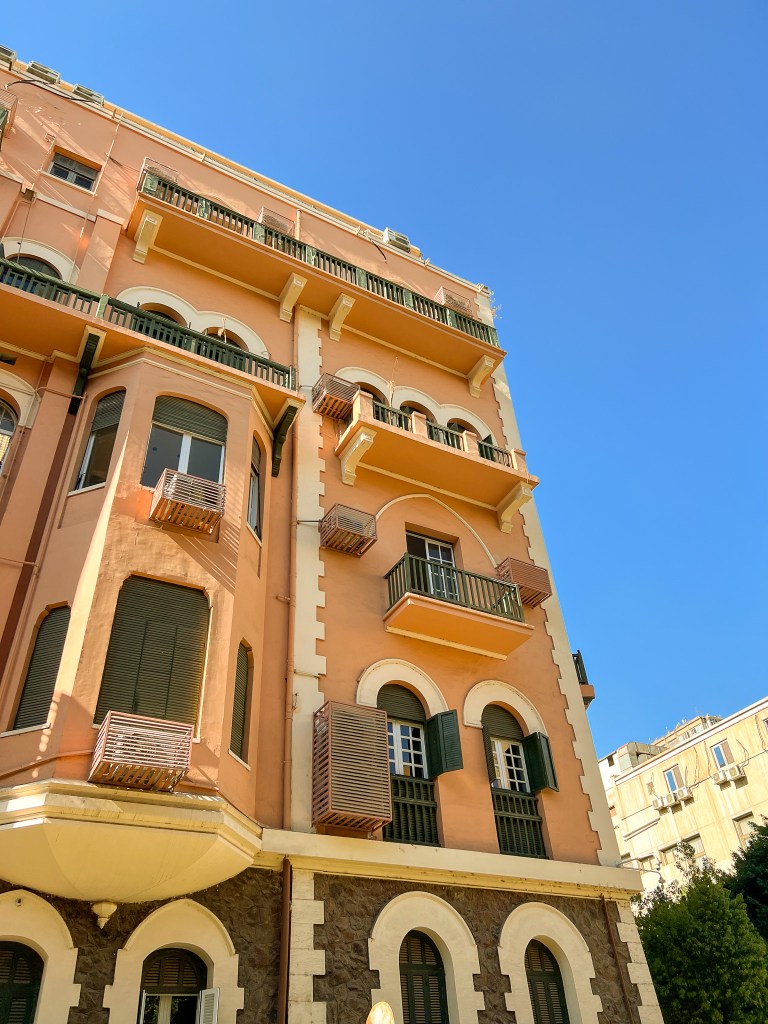
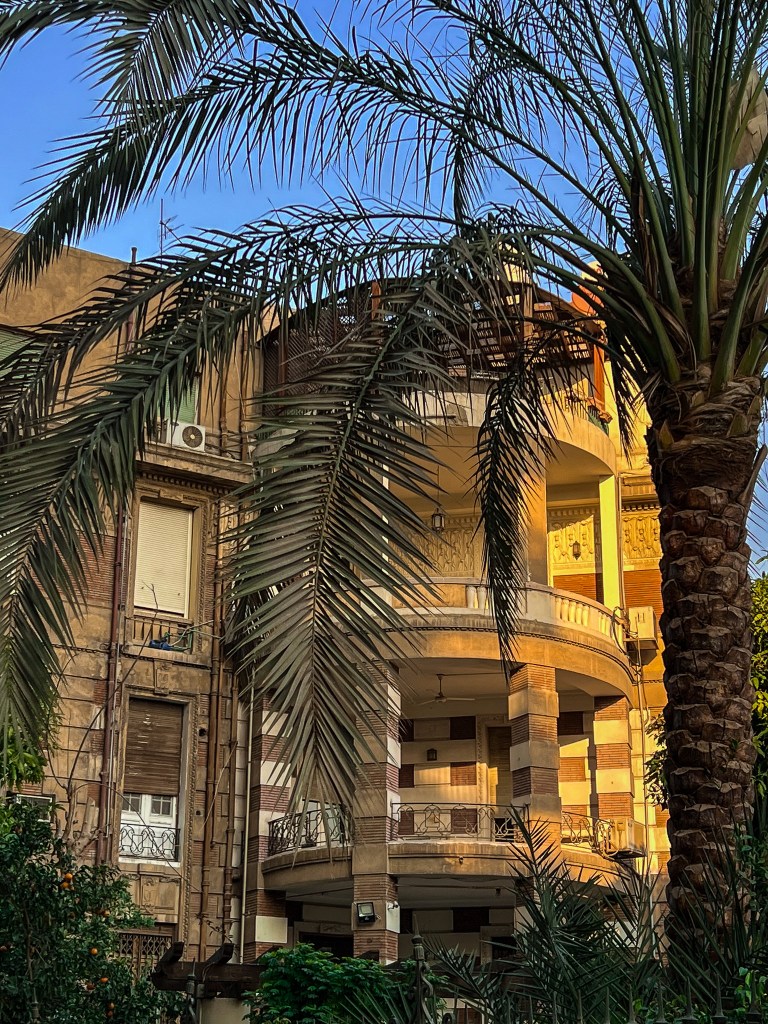


I had the address and knew that the apartment was located about two blocks off of the main drag in Zamalek, a neighborhood I know well as I lived here (albeit at the other end) when I was doing my study abroad in Cairo as a junior almost 30 years ago (and boy, does it kill me to write those words) and have stayed in or near on every subsequent return visit to Egypt.
Even at 1 in the morning, there were three men from Fulbright who met me at the flat, which turns out to be a palatial three bedroom in a building constructed, as the plaque on the front door informs me, in 1945. The kitchen and bathrooms have been updated since, and, in addition to a washing machine, it possesses that rarest of Cairo perks: a dryer.
It was past 2:30 when I got to bed and I didn’t sleep very well. The next morning, my first task after breakfast was to purchase undergarments. The receipts have since been submitted to British Airways, god knows if I’ll ever see the money.
Egypt is in the midst of a massive currency crisis; the Egyptian pound (abbreviated LE, livre Egyptien), has lost a third of its value since the beginning of December. Things are pricey—the last time I was here the exchange rate was 8 to the dollar, now it’s 30!—and I nearly had a heart attack when I was presented with a bill for a thousand pounds for two t shirts, two of the most hideous (but allegedly cotton) pairs of underwear I’ve ever bought, and two pairs of socks. In my student days that would have been prohibitively expensive; now it’s barely $30.
Did I need to go to The Body Shop for soap and shampoo? Probably not, but I’m worth it, dammit.
The currency crisis means that imported items are hard to come by and stores just randomly go out of stock on things all of a sudden (shaving cream is, for some reason, a hard to find item). While, on the one hand, I bought an external monitor for my laptop for $130 (24” and curved!), I’ve also given up ordering groceries (for everyone and everything delivers here) because invariably there’s an awkward call shortly thereafter where they try to explain to me in their best Arabic-English pastiche which items I just ordered that aren’t in stock. I’d rather just go to the store and see what’s there.
I told Victor that this reminds me of shopping for Christmas dinner in Mexico before HEB opened in Irapuato: making the rounds of at least four stores, and then figuring out where to get the one or two items that we still couldn’t find.
Fortunately, now there’s Amazon and its better stocked, Saudi owned competitor, Noon, which will deliver things direct to my door.
Getting into the research
Research in Egypt isn’t easy. It’s why I’m here, but, whereas in the UK, I showed up at the National Archives, showed my passport and got a reader’s ticket from a bored looking woman in a headscarf, that is not the case here.
I had to send off paperwork to apply for permission to work in the Egyptian National Archives (which is separate from getting permission to be in Egypt, which was a prerequisite for getting the Fulbright award in the first place). I sent it off in August, under a time crunch, and had used Google Translate to generate most of it (sue me; I haven’t had to write anything that lengthy in Arabic since I was in graduate school). I did this under the strong impression that I would be turned down flat: DWQ (the Egyptian National Archives—literally the “National House of Documents” in Arabic), which has always been a kiss-my-ring type of place, hasn’t been rolling out the red carpet to foreign scholars since the coup-that-wasn’t-a-coup installed President and Dear Leader Abdul Fatah al-Sisi in 2013. I know exactly one scholar who’s gotten in.
To my surprise, when I had my orientation meeting with the Fulbright staff, they told me that DWQ had responded, asking for more clarity on which documents, exactly, I wanted to consult. They suggested that I go and meet with the head of the Reading Room, Ms. Ragaa, and speak to her directly. I was told that she was only available Sunday and Monday (for the uninitiated, the Egyptian workweek is Sunday-Thursday, Friday being the Islamic day of communal prayer).
Since the National Archives and National Library share a building, I decided that I’d go to the archives first, get this meeting out of the way, and then proceed to the National Library to start working through the material I wanted to look at there.
Getting into DWQ itself is an exercise in patience and humiliation (also humility, but it’s clear that the onus is on the visitor who darkens its door). I went to the reception desk and said I needed to see Ms. Ragaa.
“Permit,” said the man.
“I don’t have my permit yet. That’s why I need to see her.”
“If you don’t have a permit you can’t come in.”
“She asked to see me.”
“No permit, no entry.”
“She. Asked. To see. Me.”
A phone call was made, Ms. Ragaa confirmed that, yes, in fact, she did want to see me, and I was allowed up. We went through everything I’d already written, and then re-filled out a form I’d already filled out, only this time using the proper names of the files that I wanted to look at.
(Mind you, the proper format of said names — and, indeed, the entire catalog structure itself–is available nowhere for consultation, likely on purpose).
Bear in mind I’ve been here a week and so my Arabic is divided into two categories of words: words I don’t know, and words I know I should know but have forgotten. Somehow I muddled through.
So, after the paperwork was completed properly and sent off to the machinery to ferment for another month or so, I retrieved my passport from the gatekeeper’s gatekeeper, and went outside, and thence next door to Dar al-Kutub, the national library of Egypt.
Observations.
- DK is infested with cats. I know some of you will question the use of this word, but trust me. It is appropriate.
- There are three women who run the microfilm/microfiche room. The gentleman outside who apparently oversees periodicals is clearly terrified of them as he brought me in, introduced me, and (again, I assure you of the correct word choice) scampered off as quickly as possible.
One of the women spent the entire morning giving religious advice on the phone. Her phone ring tone is the adhan. Did she excuse herself when the call to prayer was made at noon? Actually, no, she did not.
Another of them, the one who set me up with Al-Garida (July-December 1914), gossiped about me on the phone—possibly with Ms. Ragaa from the National Archives. I heard “Mister ruz … ah … ah … nafs al-ragul?” (Mr. Rose … yes … yes … the same man?), and then turned my head and she got quiet. Do not confuse this with “she stopped talking.”
Around 12:30 school apparently lets out and everyone’s kids come and sit in the room. There was much loud talking. Shhh! It’s a library! Does not apply. Next time, I’m bringing my noise cancelling headphones.

 Christopher S Rose